UPSC Completes 100 Years: History, Articles 315–323 & Key Reforms
UPSC Completes 100 Years: From the Public Service Commission of 1926 to a Modern Constitutional Body
Date: 2 October 2026
Category: National Affairs | Polity & Governance | Current Affairs
Exam Relevance: UPSC, SSC, Banking, CDS, CAPF, NDA, Railway, State PSC
What Happened?
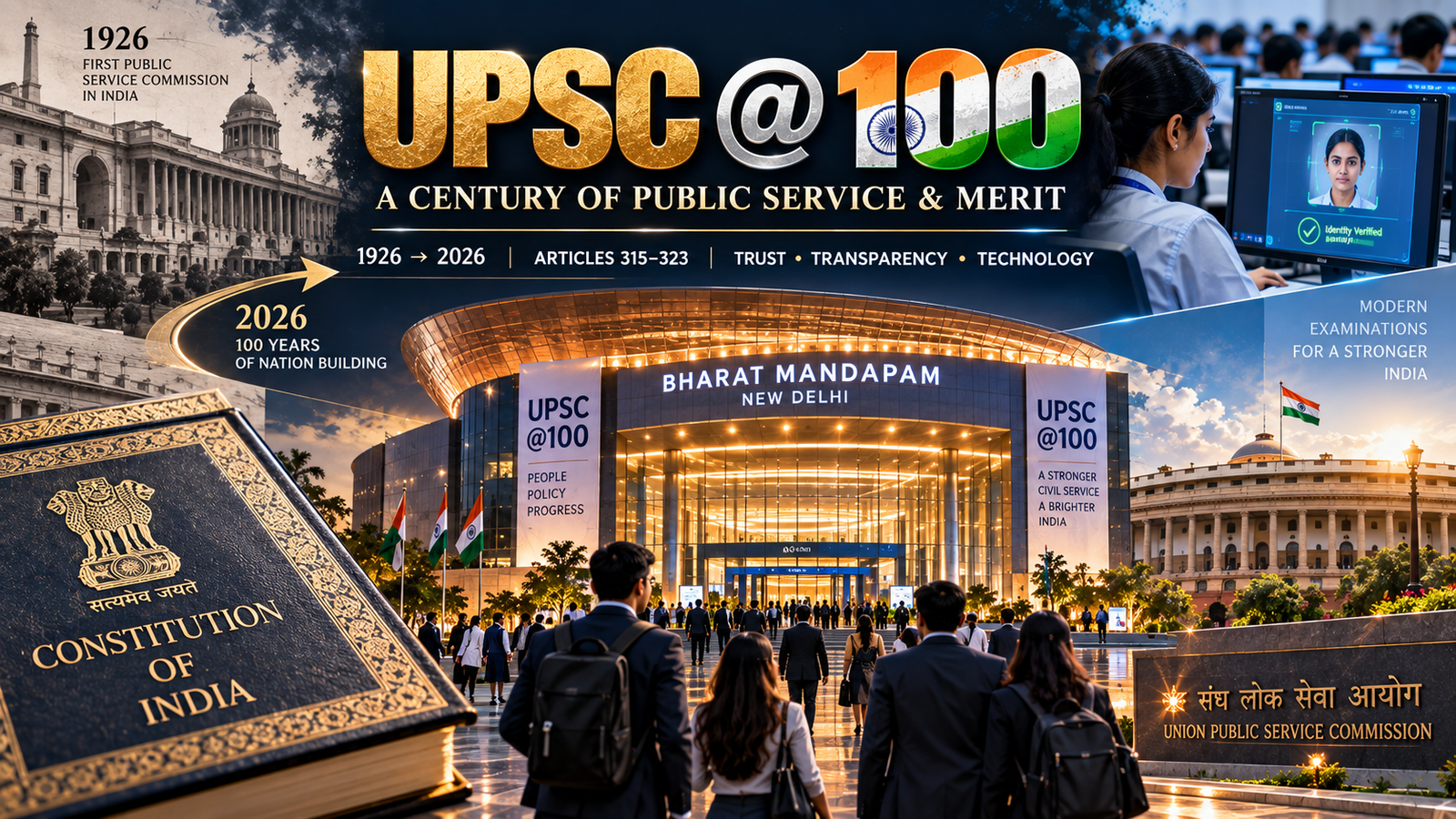
The Union Public Service Commission (UPSC) has completed 100 years of its institutional journey, marking a century since India’s first Public Service Commission was established on 1 October 1926.
The centenary celebrations culminated at Bharat Mandapam, New Delhi, on 1 October 2026. Prime Minister Narendra Modi participated in the programme and released a UPSC Centenary Commemorative Coin, a commemorative postage stamp and a book titled 100 Landmark Judgements – Shaping the Policies of UPSC and Public Service Commissions in India.
The two-day programme, titled “Shatabdi Samaroh – Manthan”, brought together members of the UPSC and State Public Service Commissions, government officials, academics and other stakeholders to discuss the future of public-service recruitment and administration.
Why Is UPSC@100 Important?
For competitive-exam aspirants, this is more than an anniversary.
The UPSC is a constitutional body responsible for conducting examinations and undertaking recruitment-related functions for various posts and services under the Union.
Its constitutional framework is contained in Part XIV of the Constitution, particularly Articles 315 to 323, which deal with Public Service Commissions for the Union and the States.
The centenary therefore provides an opportunity to revise:
- Constitutional bodies
- Public Service Commissions
- Articles 315–323
- Civil-service recruitment
- Merit-based selection
- Administrative reforms
- Technology in examinations
- Evolution of India’s public administration
From 1926 to 2026: A Century of Evolution
The history of the UPSC goes back to the colonial period.
1926 — First Public Service Commission
On 1 October 1926, India’s first Public Service Commission was constituted.
At that time, it was an advisory body, and its Chairman and Members were appointed by the Secretary of State in London.
1935 — Government of India Act
The Government of India Act, 1935 provided for the establishment of Federal and Provincial Public Service Commissions.
1937 — Federal Public Service Commission
The Federal Public Service Commission came into existence in 1937.
1950 — Constitutional Status
With the adoption of the Constitution, the Public Service Commission at the Union level became the Union Public Service Commission (UPSC) and received constitutional status.
Today, UPSC operates within the framework of Articles 315–323 of the Constitution.
2026 — Centenary
In 2026, the institution completed 100 years since the establishment of the first Public Service Commission in India.
UPSC’s Constitutional Position
One of the most important facts for examinations is that UPSC is a constitutional body, not merely a statutory or executive body.
Constitutional Articles to Remember
| Article | Subject |
|---|---|
| Article 315 | Public Service Commissions for the Union and the States |
| Article 316 | Appointment and term of office of members |
| Article 317 | Removal and suspension of a member |
| Article 318 | Regulations regarding conditions of service |
| Article 319 | Restrictions on holding offices after membership |
| Article 320 | Functions of Public Service Commissions |
| Article 321 | Power to extend functions |
| Article 322 | Expenses of Public Service Commissions |
| Article 323 | Reports of Public Service Commissions |
Quick Revision:
👉 UPSC + State PSCs = Articles 315–323
UPSC’s Role in Public Service Recruitment
UPSC conducts examinations and recruitment processes for several important positions and services under the Union.
Some major examinations associated with UPSC include:
- Civil Services Examination
- Engineering Services Examination
- Combined Defence Services Examination
- National Defence Academy & Naval Academy Examination
- Combined Medical Services Examination
- Indian Forest Service Examination
- Central Armed Police Forces (Assistant Commandants) Examination
The Commission also performs other constitutional functions related to recruitment, appointments, promotions and disciplinary matters.
UPSC’s New Focus: Trust, Transparency & Technology
During the centenary discussions, UPSC Chairman Dr. Ajay Kumar outlined three guiding principles for the Commission’s next phase:
Trust
Building confidence in the recruitment process.
Transparency
Making examination and recruitment procedures more transparent and accountable.
Technology
Using technology to improve examination integrity, accessibility and efficiency.
This represents an important shift from simply conducting examinations towards building a more technology-enabled recruitment ecosystem.
AI-Based Facial Authentication in UPSC Exams
One of the most significant technological developments highlighted during the centenary discussions was AI-based facial authentication.
UPSC conducted a pilot of the technology at selected centres during the NDA & NA (II) and CDS (II) examinations in September 2025.
The system was subsequently implemented at scale for the Civil Services (Preliminary) Examination on 24 May 2026, covering approximately 5.50 lakh candidates.
The system uses invigilators’ mobile phones for facial authentication, with the authentication process taking approximately 6–8 seconds per candidate, according to the government release.
Why is this important?
It demonstrates how technologies such as:
AI + Digital Identity + Facial Authentication + Cybersecurity
are increasingly being incorporated into large-scale public examinations.
Universal Registration Number
Another recent reform highlighted by UPSC is the Universal Registration Number (URN), introduced in 2025.
The system is part of UPSC’s effort to improve the digital experience of candidates and streamline interactions with the Commission.
Other technology-related initiatives mentioned by UPSC include:
- Digital e-Admit Cards
- Candidate Helpdesk
- Expanded examination centres
- Provisional answer keys
- QPRep portal
- Digital infrastructure upgrades
- Cybersecurity strengthening
- AI training for officials
UPSC and Examination Reform
The centenary discussions also focused on what future examinations should assess.
UPSC Chairman Dr. Ajay Kumar emphasised the importance of assessing candidates for qualities such as:
- Reasoning
- Spontaneous thinking
- Judgement
- Ability to deal with ambiguity
rather than simply testing the ability to reproduce predictable or coached answers.
This is particularly relevant for aspirants because it reflects a broader discussion around the changing nature of competitive examinations.
UPSC and Constitutional Governance
The importance of UPSC goes beyond recruitment.
Public Service Commissions are designed to support a system where recruitment to public services is based on competitive examination, merit, fairness and constitutional principles.
During the centenary discussions, speakers also examined the evolution of public recruitment from earlier systems of patronage towards a constitutional framework based on competitive selection and public trust.
The constitutional position of Public Service Commissions is therefore closely connected with themes such as:
Equality → Merit → Fair Competition → Public Administration → Constitutional Governance
UPSC@100: Key Timeline
1855
The Indian Civil Service examination was introduced in London, replacing the East India Company’s nomination-based system with competitive examination.
1926
India’s first Public Service Commission was established.
1937
Federal Public Service Commission came into existence.
1950
UPSC acquired its constitutional status under the Constitution of India.
1978
UPSC began using computers as part of its technological evolution.
2025
Universal Registration Number was introduced.
2025–26
Centenary year celebrations were conducted.
2026
AI-based facial authentication was implemented at scale for Civil Services Preliminary Examination.
1 October 2026
UPSC completed 100 years and the centenary celebrations culminated at Bharat Mandapam, New Delhi.
Why This Current Affair Matters for Exams
UPSC
This topic can be connected with:
- Constitutional Bodies
- Articles 315–323
- Civil Services
- Governance
- Administrative reforms
- Digital governance
- Artificial Intelligence
- Transparency and accountability
- Public administration
SSC & Railway
Focus on factual questions:
- UPSC established → 1926
- Constitutional status → 1950
- Constitutional provisions → Articles 315–323
- Centenary → 2026
- Headquarters → New Delhi
CDS / NDA / CAPF
UPSC is particularly relevant because these examinations are conducted by the Commission, including NDA & NA, CDS and CAPF (AC) examinations.
Important Facts at a Glance
| Fact | Answer |
|---|---|
| UPSC’s institutional journey began | 1 October 1926 |
| Centenary year | 2026 |
| Constitutional status | 1950 |
| Constitutional Articles | 315–323 |
| Current UPSC Chairman | Dr. Ajay Kumar |
| Centenary event venue | Bharat Mandapam, New Delhi |
| Centenary programme | Shatabdi Samaroh – Manthan |
| Key principles highlighted | Trust, Transparency & Technology |
| AI facial authentication | Implemented at scale in CSE Prelims 2026 |
| CSE 2026 candidates covered by facial authentication | Approx. 5.50 lakh |
| Universal Registration Number | Introduced in 2025 |
Competitive Exam MCQs
Q1. The first Public Service Commission in India was established in which year?
A. 1919
B. 1926
C. 1935
D. 1937
Answer: B. 1926
Q2. Which Part of the Constitution of India deals with Public Service Commissions?
A. Part XII
B. Part XIII
C. Part XIV
D. Part XV
Answer: C. Part XIV
Q3. Articles 315 to 323 of the Constitution primarily deal with:
A. Election Commission
B. Finance Commission
C. Public Service Commissions
D. Union and State Legislatures
Answer: C. Public Service Commissions
Q4. UPSC completed 100 years of its institutional journey in:
A. 2024
B. 2025
C. 2026
D. 2027
Answer: C. 2026
Q5. Which three principles were highlighted by the UPSC Chairman for the Commission’s next phase?
A. Speed, Scale and Security
B. Trust, Transparency and Technology
C. Merit, Money and Management
D. Equality, Economy and Efficiency
Answer: B. Trust, Transparency and Technology
One-Line Revision
UPSC completed 100 years on 1 October 2026, marking a century since India’s first Public Service Commission was established in 1926; its constitutional framework today is contained in Articles 315–323, with the Commission’s next phase focusing on Trust, Transparency and Technology.
Conclusion
The UPSC@100 milestone provides an important opportunity to understand how India’s public-service recruitment system evolved from the first Public Service Commission established in 1926 into an independent constitutional body.
Its centenary discussions also highlight how public recruitment is entering a new phase shaped by AI, digital authentication, cybersecurity, transparency and changing approaches to examination design.
For competitive-exam aspirants, this single current affair connects Polity, Governance, History, Constitutional Bodies, Technology and Public Administration, making it a high-value topic for revision.