
PCM vs PCB vs PCMB After Class 10: Which Stream Should You Choose?
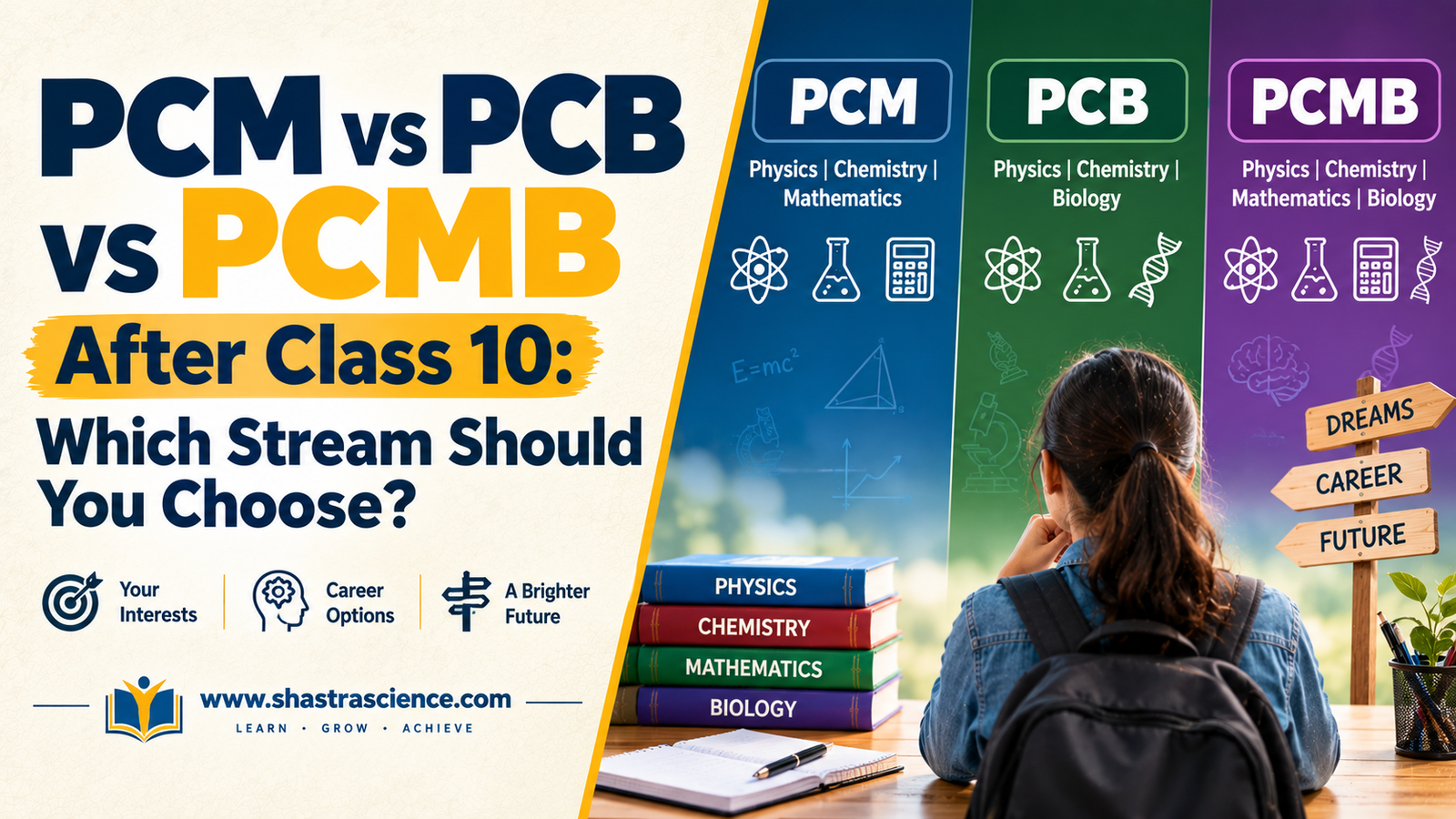
In this guide, we will explain the differences between PCM, PCB, and PCMB, their subjects, career options, entrance examinations, and the factors you should consider before making your decision.
What Are PCM, PCB, and PCMB?
PCM, PCB, and PCMB are combinations of science subjects generally offered in Classes 11 and 12. The main difference is whether you study Mathematics, Biology, or both.
- PCM: Physics, Chemistry, and Mathematics.
- PCB: Physics, Chemistry, and Biology.
- PCMB: Physics, Chemistry, Mathematics, and Biology.
All three combinations usually include English and may include additional subjects depending on the school or education board. Before selecting a combination, check which subjects your school offers and whether they meet the eligibility requirements for your intended career.
1. PCM After Class 10: Subjects and Career Options
PCM stands for Physics, Chemistry, and Mathematics. It is a popular choice among students interested in engineering, technology, mathematics, physical sciences, and several defence-related career pathways.
Subjects in PCM
- Physics: Covers motion, electricity, magnetism, waves, energy, and other physical principles.
- Chemistry: Includes physical, organic, and inorganic chemistry, helping students understand matter and chemical reactions.
- Mathematics: Covers topics such as algebra, trigonometry, calculus, coordinate geometry, and probability.
PCM requires regular practice, particularly in Mathematics and numerical problem-solving. Students who enjoy logical thinking, calculations, and understanding how things work may find this combination suitable.
Career Options After PCM
PCM can provide a pathway towards several fields, depending on your further education, entrance examination results, and eligibility.
- Engineering: Computer Science, Mechanical, Civil, Electrical, Electronics, and other engineering disciplines.
- Computer Science and IT: Software development, data-related fields, cybersecurity, and information technology.
- Architecture: Architecture programmes that require the relevant subjects and entrance qualifications.
- Pure Sciences: Physics, Mathematics, Chemistry, and research-oriented degree programmes.
- Defence: Certain officer-entry routes, including the National Defence Academy examination, subject to the requirements of the chosen service.
- Merchant Navy: Certain nautical science and marine engineering pathways, subject to course-specific academic and medical requirements.
Entrance Exams for PCM Students
Depending on your chosen course, you may consider examinations such as:
- JEE Main: Used for admission to many engineering programmes and as a qualifying route for JEE Advanced.
- JEE Advanced: The entrance examination for undergraduate admission to IITs, subject to eligibility criteria.
- NDA and NA Examination: Conducted by UPSC for eligible candidates seeking admission to the National Defence Academy or Naval Academy. The required subjects depend on the service and entry route.
- NATA or other accepted architecture admission routes: Requirements depend on the institution and admission process.
Always check the latest official admission brochure before selecting subjects based on a particular examination.
2. PCB After Class 10: Subjects and Career Options
PCB stands for Physics, Chemistry, and Biology. It is commonly chosen by students interested in medicine, healthcare, life sciences, biotechnology, and the study of living organisms.
Subjects in PCB
- Physics: Develops an understanding of physical principles and numerical problem-solving.
- Chemistry: Covers chemical reactions, matter, and concepts that are important in many medical and life-science fields.
- Biology: Includes topics such as cell biology, genetics, human physiology, plant biology, ecology, and evolution.
Students who are curious about the human body, living organisms, diseases, plants, animals, and the natural world may enjoy Biology. However, PCB also requires conceptual understanding, regular revision, and the ability to learn and connect a large amount of information.
Career Options After PCB
PCB can lead to several healthcare and science-related careers. Studying Biology does not mean that becoming a doctor is your only option.
- Medicine: MBBS and other medical programmes where the student meets the applicable eligibility criteria.
- Dental Sciences: BDS and related dental-care pathways.
- Veterinary Science: Education and careers involving animal health and treatment.
- Pharmacy: Pharmaceutical sciences and careers in the medicine industry, subject to course requirements.
- Nursing and Allied Health Sciences: Nursing, medical laboratory technology, radiology-related fields, and other healthcare programmes.
- Biotechnology and Life Sciences: Biology-based research, biotechnology, microbiology, and related fields.
- Agriculture and Environmental Sciences: Study of crops, ecosystems, biodiversity, and environmental management.
Entrance Exams for PCB Students
- NEET-UG: The principal entrance examination for MBBS, BDS, and several other medical programmes covered by its admission framework.
- CUET-UG: Used by participating universities for selected undergraduate programmes. Available courses and subject requirements vary by university.
- University-specific entrance examinations: Some institutions use their own admission processes for particular science and healthcare programmes.
Not every Biology-related course requires NEET-UG. Check the official admission requirements of the programme and institution you want to join.
3. PCMB After Class 10: Is Studying Both Mathematics and Biology a Good Choice?
PCMB stands for Physics, Chemistry, Mathematics, and Biology. Students choosing this combination study both Mathematics and Biology along with Physics and Chemistry.
The main advantage of PCMB is that it can keep more science-related pathways open. For example, a student may be interested in engineering but also want to explore medical or life-science options. Studying both subjects can help them investigate these possibilities before making a final career decision.
Advantages of PCMB
- Broader subject choices: You study both Mathematics and Biology, which may support eligibility for a wider range of programmes.
- More flexibility: You can explore selected engineering, medical, and science-related options, subject to their individual requirements.
- Opportunity to explore interests: PCMB may suit students who genuinely enjoy both mathematical problem-solving and biological concepts.
Challenges of PCMB
- Higher study load: You must manage four demanding science subjects rather than three.
- Time management: Balancing Mathematics practice with Biology revision can be challenging.
- Exam preparation: Preparing for multiple entrance examinations may become difficult if your goals are not clear.
PCMB is not automatically better than PCM or PCB. It is most suitable for students who have a genuine interest in both Mathematics and Biology and can manage the additional workload. If you are choosing PCMB only because you are afraid of closing a career option, first compare the actual eligibility rules for your preferred courses.
PCM vs PCB vs PCMB: Comparison Table
Use this table to compare the three combinations before deciding which stream to choose after Class 10.

| Factor | PCM | PCB | PCMB |
|---|---|---|---|
| Main subjects | Physics, Chemistry, Mathematics | Physics, Chemistry, Biology | Physics, Chemistry, Mathematics, Biology |
| Best suited for | Students interested in maths, engineering, technology, and physical sciences | Students interested in medicine, healthcare, and life sciences | Students interested in both mathematical and biological sciences |
| Common pathways | Engineering, IT, mathematics, physics, selected defence routes | Medicine, dentistry, pharmacy, nursing, biotechnology, life sciences | Selected pathways available to both Mathematics and Biology students |
| Study demands | Regular numerical practice and conceptual learning | Conceptual learning, diagrams, revision, and numerical practice in Physics and Chemistry | All PCM demands plus Biology, requiring careful time management |
| Key consideration | Choose it if Mathematics fits your interests and goals | Choose it if Biology fits your interests and goals | Choose it if you can manage both subjects and have a reason to study them |
Remember: This comparison is a general guide. Admission rules differ by course, university, entrance examination, and year. Studying a particular combination does not guarantee admission or eligibility for every career listed.
Which Stream Should You Choose for JEE, NEET, NDA, or Merchant Navy?
If you already have a career goal, start by checking the subjects required for that pathway instead of choosing a stream based only on popularity.
- For JEE and engineering: PCM is the usual choice because Mathematics is a key subject for these pathways. Check the current JEE and institution-specific eligibility rules.
- For NEET and MBBS: PCB is a common choice, but students should check the current subject and eligibility requirements for NEET-UG and the medical programme they want to pursue.
- For NDA: Students interested in the Army, Navy, or Air Force should understand that educational requirements differ by service. Mathematics and Physics requirements are particularly important for the Air Force and Naval pathways. Verify the latest UPSC notification.
- For Merchant Navy: Some nautical science and marine engineering programmes require Physics, Chemistry, and Mathematics. Academic marks, age, medical fitness, and other conditions can also apply, so check the relevant institute and maritime admission rules.
- For CUET-UG: Choose subjects after reviewing the eligibility and subject-combination requirements of the universities and courses you are targeting.
For students who are unsure about their career, making a shortlist of two or three possible courses and checking their official eligibility requirements can make the decision much easier.
How to Choose the Right Stream After Class 10
Before making your final decision about PCM vs PCB after Class 10, consider these practical steps.
1. Identify the Subjects You Enjoy
Think about the subjects you find interesting, not just the ones in which you score the highest marks. If you enjoy solving mathematical problems, PCM may suit you. If you are curious about living organisms and human biology, PCB may be worth considering. If you enjoy both, explore whether PCMB is manageable for you.
2. Understand Your Strengths
Review your Class 9 and 10 performance, teacher feedback, and study habits. Marks are useful, but they should not be your only deciding factor. Also consider whether you are willing to practise Mathematics regularly or revise Biology consistently.
3. Research Your Career Options
Do not choose a stream based on a single job title or advice from friends. Research the courses, entrance examinations, duration of study, approximate costs, and future work involved in your preferred fields. Use official university and examination websites for eligibility details.
4. Consider Your Workload
PCMB can offer flexibility, but the extra subject requires time and effort. Be realistic about your ability to manage schoolwork, revision, and entrance-exam preparation. A focused choice can be more useful than taking an additional subject without a clear purpose.
5. Discuss Your Decision With the Right People
Speak with teachers, parents, and academic counsellors who can explain the subjects and their demands. Ask students already studying the stream about their daily workload and the areas they find difficult. Then make a decision based on your own interests and goals.
Common Mistakes to Avoid When Choosing a Stream
- Following your friends: Your friends may have different interests and career plans. Choose according to your own goals.
- Choosing only for social status: No science combination is universally superior. Each serves different interests and pathways.
- Assuming PCB has no options outside medicine: PCB students can explore several healthcare, research, and life-science fields.
- Selecting PCMB without considering the workload: More subjects can mean more flexibility, but they also require more preparation.
- Ignoring eligibility requirements: Some courses have specific subject, marks, age, or medical requirements. Check official rules before deciding.
- Making a decision based only on Class 10 marks: Consider your interests, willingness to learn, study habits, and long-term goals as well.
Frequently Asked Questions
1. Which is better, PCM or PCB after Class 10?
Neither is universally better. PCM is generally suitable for students interested in Mathematics, engineering, technology, and physical sciences. PCB is generally suitable for students interested in medicine, healthcare, and life sciences. Your interests and intended course should guide your decision.
2. Can I become a doctor after choosing PCM?
For medical admission through NEET-UG, candidates must meet the applicable subject and eligibility requirements. PCM alone does not normally provide the required Biology/Biotechnology subject combination for standard medical eligibility. Check the current official NEET-UG information bulletin before making a decision.
3. Can I prepare for JEE and NEET with PCMB?
Studying PCMB includes the core science subjects relevant to both pathways, but preparing for JEE and NEET together can create a heavy workload. Check the current eligibility criteria for each examination and consider whether you have enough time to prepare effectively for both.
4. Is PCMB harder than PCM or PCB?
PCMB often involves a greater study load because it includes both Mathematics and Biology. How difficult it feels depends on your interests, subject strengths, time management, and study routine.
5. Which stream is best for NDA after Class 10?
The best choice depends on the service you want to pursue. The Army wing and the Naval and Air Force pathways have different educational requirements. Review the latest UPSC NDA and NA notification before selecting your Class 11 subjects.
6. Can I change my stream after Class 11?
Changing streams may be possible in some schools, but it depends on school policy, board rules, subject availability, and the time at which you request the change. Ask your school before making a decision, and avoid assuming that a change will always be permitted.
7. What should I do if I am confused between PCM and PCB?
Compare your interests, review the careers you are considering, and check their subject requirements. Speak with a teacher or academic counsellor and make a shortlist of realistic options before choosing.
Get Guidance Before Choosing Your Stream
Choosing between PCM, PCB, and PCMB is an important step, but you do not need to make the decision based on guesswork. Understanding the subjects, career pathways, entrance examinations, and workload can help you make a more informed choice.
If you are a Class 10 student or parent looking for academic guidance, Shastra Science Institute can be a starting point for discussing your study goals and preparation plans. Before enrolling in any course, ask about the syllabus, teaching support, schedule, and how the programme fits your intended pathway.
Take the time to choose a stream that matches your interests, strengths, and future plans. The right decision is not necessarily the most popular one; it is the one you can study with purpose and confidence.