
India Joins Global 6G Initiative: Why It Matters for India
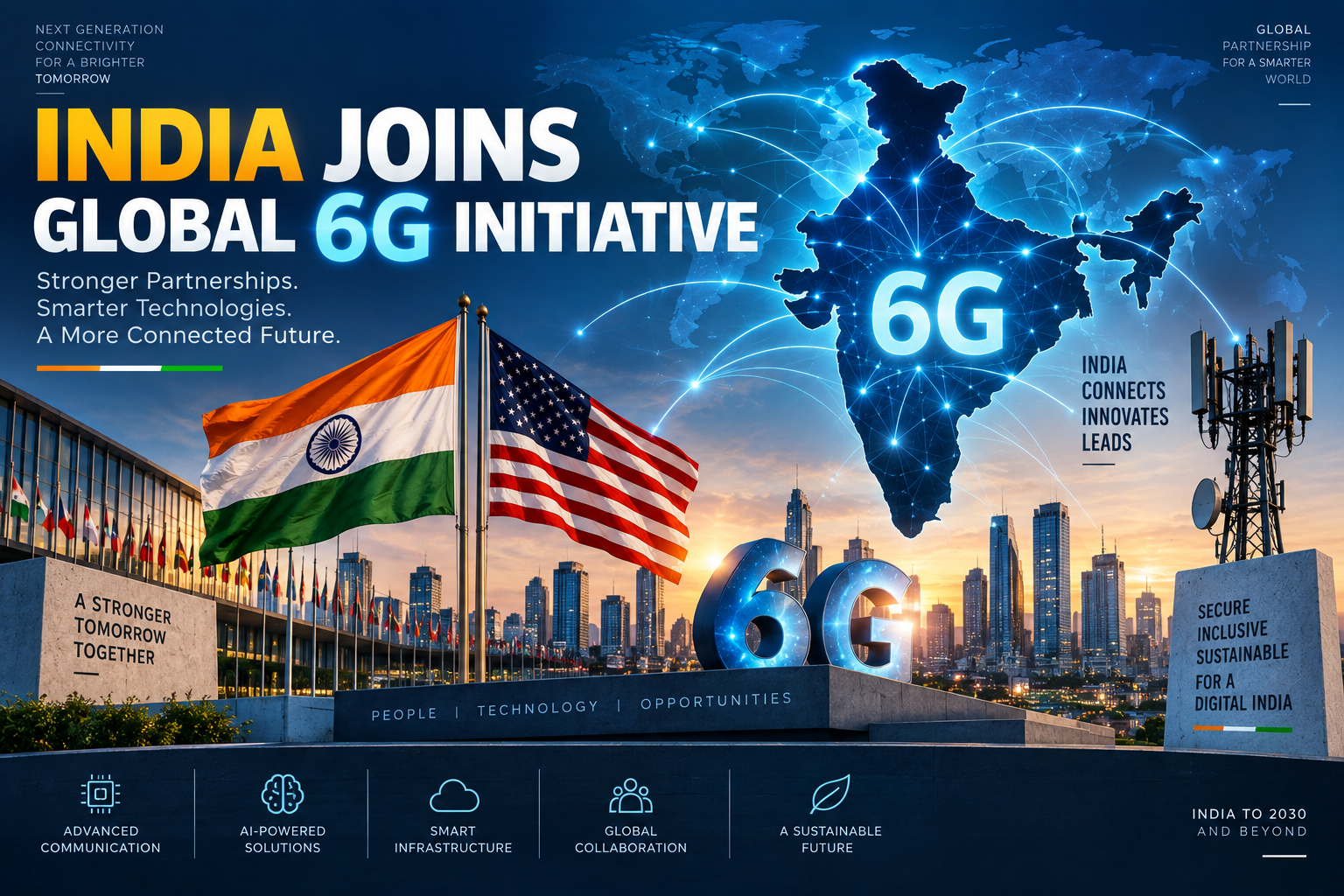
India Joins US-Led Global 6G Initiative: What It Means for India
Category: Science & Technology | International Affairs | Current Affairs
Date: September 9, 2026
Exam Relevance: UPSC, SSC, Banking, Railway, Defence, State PSC
India Joins Global 6G Initiative Alongside US and 24 Other Countries
India has taken another major step towards becoming a global player in next-generation telecommunications by joining a US-led international initiative focused on the development and security of 6G networks.
The United States announced India’s participation after discussions between US Commerce Secretary Howard Lutnick and India’s Minister of State for Commerce and Industry, Jitin Prasada, on the sidelines of the G20 Innovation Ministerial held in Chapel Hill, North Carolina.
The initiative brings together the United States, India and 24 other countries to cooperate on the development of secure, competitive and innovative 6G networks.
For competitive-exam aspirants, this development is important because it connects 6G technology, India-US relations, artificial intelligence, semiconductors, data centres, digital infrastructure and India’s technology ambitions.
What is the 6G Initiative?
6G refers to the sixth generation of wireless communication technology, which is expected to succeed 5G.
While 5G has focused heavily on faster connectivity, lower latency and connecting large numbers of devices, 6G is expected to enable even more advanced applications involving:
- Artificial Intelligence
- Advanced robotics
- Autonomous systems
- Smart cities
- Immersive communication
- Internet of Things (IoT)
- High-speed data networks
- Advanced sensing and connectivity
The new international initiative aims to encourage cooperation among participating countries so that future networks are secure, interoperable, resilient and innovation-friendly.
The participating governments are expected to coordinate their 6G strategies before the technology becomes commercially widespread.
Why is India’s Participation Important?
India’s entry into the initiative is significant for several reasons.
1. India Wants a Role in Global 6G Standards
Telecommunication standards determine how networks and devices communicate with one another.
By participating early in international discussions, India can contribute to the development of future telecom standards instead of simply adopting standards developed by others.
This could strengthen India’s position in the global telecommunications ecosystem.
2. Supports India’s Bharat 6G Mission
India is already working towards developing indigenous 6G capabilities.
The Bharat 6G Vision was released in 2023 and aims to make India a significant contributor to the design, development and deployment of 6G technology by 2030.
The government has also been expanding the Bharat 6G Alliance, bringing together industry and academic institutions.
Therefore, India’s participation in the international initiative complements its domestic 6G efforts.
3. Strengthens India-US Technology Cooperation
The development is not limited to 6G.
During the India-US discussions, both sides also discussed cooperation in:
- Semiconductors
- Artificial Intelligence
- Data Centres
- Digital technologies
This indicates that India-US technology cooperation is expanding beyond traditional areas into critical emerging technologies.
What Could 6G Mean for India’s Future?
The importance of 6G goes far beyond faster mobile internet.
Future wireless networks could become an important foundation for technologies such as AI-powered systems, autonomous vehicles, industrial robotics, smart infrastructure and advanced digital services.
For India, developing domestic capabilities in these areas could help create:
- High-skilled employment
- New technology startups
- Intellectual property
- Indigenous telecom equipment
- Export opportunities
- Stronger digital infrastructure
India’s objective is therefore not simply to become a large consumer of 6G technology but also to participate in its development and global standardisation.
5G vs 6G: What Should Students Know?
| Feature | 5G | 6G |
|---|---|---|
| Generation | Fifth generation | Sixth generation |
| Current status | Being deployed globally | Under research and development |
| Main focus | High-speed connectivity & low latency | Next-generation intelligent connectivity |
| Role of AI | Important | Expected to be deeply integrated |
| Applications | IoT, smart cities, autonomous systems | Advanced AI, robotics, sensing and immersive systems |
| India initiative | 5G rollout | Bharat 6G Mission / Vision |
Important: 6G should not be confused with an already-deployed consumer network. It is still under development and standardisation.
India and Bharat 6G Mission
India released its Bharat 6G Vision document on March 22, 2023.
The vision aims to position India as a frontline contributor in the design, development and deployment of 6G technology by 2030.
The Bharat 6G Alliance (B6GA) brings together stakeholders from industry, academia and research to strengthen India’s capabilities in next-generation telecommunications.
In March 2026, the Ministry of Communications said the Bharat 6G Alliance had expanded substantially and highlighted India’s ambition to increase its role in global 6G patents and international standards.
Why This News Matters for Competitive Exams
This single current-affairs development can be linked with multiple areas of the syllabus.
UPSC
GS Paper II
- India-US Relations
- International cooperation
GS Paper III
- Science & Technology
- Telecommunications
- Artificial Intelligence
- Digital infrastructure
- Emerging technologies
SSC / Railway / Banking
Questions can be asked about:
- 6G
- Bharat 6G Mission
- Bharat 6G Alliance
- India-US technology cooperation
- Semiconductors
- Artificial Intelligence
- G20 Innovation Ministerial
Defence Exams
6G can also be relevant to secure communications, advanced networks, autonomous systems and emerging defence technologies.
Important Facts to Remember
| Topic | Key Fact |
|---|---|
| Latest development | India joined a global 6G initiative |
| Lead country | United States |
| Other participating countries | US + India + 24 other countries |
| Technology | 6G |
| Key objective | Secure, competitive and innovative next-generation networks |
| Indian representative in discussions | Jitin Prasada |
| US representative | Howard Lutnick |
| Event | G20 Innovation Ministerial |
| Location of G20 Innovation Ministerial | Chapel Hill, North Carolina |
| India’s 6G roadmap | Bharat 6G Vision |
| Bharat 6G Vision released | March 22, 2023 |
| Target | India as a frontline contributor to 6G by 2030 |
The participation was announced by the US Department of Commerce following India-US discussions at the G20 Innovation Ministerial.
Competitive Exam MCQs
Q1. India recently joined a global initiative focused on the development of which technology?
A. 4G
B. 5G
C. 6G
D. 7G
Answer: C. 6G
Q2. India joined the US-led 6G initiative along with how many other countries?
A. 10
B. 15
C. 24
D. 50
Answer: C. 24
Q3. India’s Bharat 6G Vision primarily aims to:
A. Replace all existing 4G networks immediately
B. Make India a frontline contributor to 6G by 2030
C. Ban foreign telecom equipment
D. Provide free 6G smartphones to citizens
Answer: B. Make India a frontline contributor to 6G by 2030
Q4. Which of the following technologies were discussed between India and the US alongside 6G?
- Semiconductors
- Artificial Intelligence
- Data Centres
A. 1 only
B. 1 and 2 only
C. 2 and 3 only
D. 1, 2 and 3
Answer: D. 1, 2 and 3
Q5. The Bharat 6G Vision document was released in:
A. 2021
B. 2022
C. 2023
D. 2025
Answer: C. 2023
Key Takeaway
India’s participation in the global 6G initiative is more than a telecommunications development. It reflects India’s growing ambition to participate in the global technology ecosystem, contribute to international standards and develop indigenous capabilities in critical emerging technologies.
For students preparing for competitive examinations, remember the chain:
6G → India-US Cooperation → Bharat 6G Vision → AI & Semiconductors → Digital Infrastructure → Technology & Global Standards
That connection can turn a current-affairs headline into a potential UPSC, SSC, Banking or Defence exam question.
SSI — Learn Today. Lead Tomorrow.