BRICS New Delhi Declaration 2026: Key Outcomes & Exam Facts
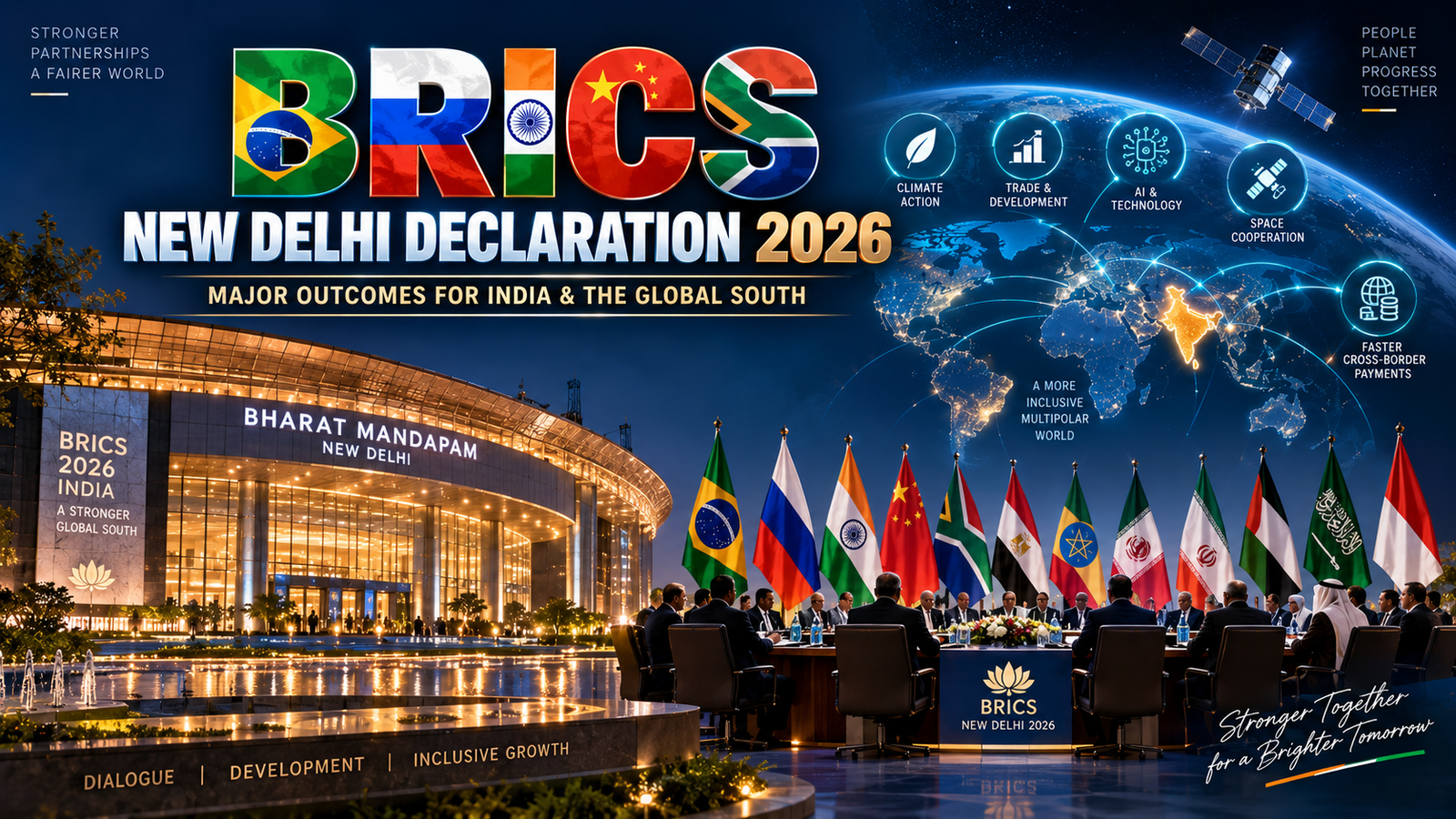
BRICS Adopts New Delhi Declaration 2026: India Secures Major Consensus on Terrorism, Global Governance, Trade & AI
Category: International Affairs | Economy | Science & Technology
Date: September 13, 2026
Exam Relevance: UPSC, SSC, Banking, Defence, Railway, State PSC
The 18th BRICS Summit in New Delhi has produced a major diplomatic outcome: BRICS leaders adopted the New Delhi Declaration on September 12, calling for stronger multilateralism, reform of global institutions, cooperation against terrorism, greater economic coordination, and deeper collaboration in areas such as Artificial Intelligence, digital payments, energy, climate resilience and space technology.
The declaration is particularly important for India because it explicitly condemns the April 22, 2025 terrorist attack in Jammu & Kashmir that killed 26 people, calls for “zero tolerance” toward terrorism, and reiterates support for greater representation of developing countries in the UN Security Council, including support from China and Russia for the aspirations of India and Brazil to play a greater role in the UN.
For competitive-exam students, this is arguably the most important international-relations current-affairs development of the day because a single declaration connects India’s foreign policy, Global South, UN reforms, terrorism, WTO, trade, AI, climate change, energy security, digital payments and the New Development Bank.
What Happened?
India is hosting the 18th BRICS Summit in New Delhi on September 12–13, 2026, under its 2026 Chairship.
The summit is being held under the theme:
“Building for Resilience, Innovation, Cooperation and Sustainability.”
The New Delhi Declaration states that BRICS leaders met in New Delhi for the 18th Summit and reaffirmed cooperation under three broad pillars:
- Political and Security
- Economic and Financial
- Cultural and People-to-People Cooperation
The declaration also notes that more than 400 meetings and engagements were conducted across 30 cities in India during the 2026 Chairship.
Why Is the New Delhi Declaration Important?
1. Strong Condemnation of Terrorism
One of the most important India-specific outcomes is the declaration’s strong language on terrorism.
BRICS leaders condemned the April 22, 2025 terrorist attack in Jammu & Kashmir, in which 26 people were killed.
The declaration reaffirmed commitment to combating terrorism in all its forms, including:
- Cross-border movement of terrorists
- Terror financing
- Terrorist safe havens
- Extremism and radicalisation
It also called for zero tolerance for terrorism and urged faster progress towards the Comprehensive Convention on International Terrorism under the UN framework.
Exam Connection
BRICS → Counter-Terrorism Working Group → Terror Financing → Comprehensive Convention on International Terrorism
This is highly relevant for UPSC GS-II, Defence exams and international-relations questions.
2. China and Russia Back India’s UN Role
Another major diplomatic takeaway is the declaration’s support for reform of the United Nations Security Council.
BRICS reiterated the need for a more:
- Democratic
- Representative
- Effective
- Efficient
UN system.
Importantly, China and Russia, both permanent members of the Security Council, reiterated support for the aspirations of Brazil and India to play a greater role in the UN, including the Security Council.
Why Does This Matter?
India has long sought permanent membership of a reformed UN Security Council.
Therefore, this statement is relevant to India’s long-term diplomatic objective of securing a greater role in global decision-making.
3. BRICS Pushes for Global Governance Reform
The declaration argues that the current international architecture should better reflect contemporary geopolitical and economic realities.
BRICS reiterated support for:
- Multilateralism
- Multipolarity
- International law
- UN reform
- Greater representation of developing countries
The grouping also called for reform of the Bretton Woods Institutions, particularly the IMF and World Bank, so that representation better reflects the changing global economy.
What Are Bretton Woods Institutions?
The term generally refers to the major institutions created at the 1944 Bretton Woods Conference, particularly:
- International Monetary Fund (IMF)
- World Bank
This is a very important static-GK + current-affairs connection for competitive exams.
4. BRICS Opposes Unilateral Trade Restrictions
Trade was another important part of the New Delhi Declaration.
BRICS expressed concern about unilateral protectionist measures, tariffs and non-tariff barriers that can distort international trade.
The declaration emphasised the need for:
- Stable supply chains
- Predictable trade
- Greater participation of developing countries
- Technology transfer
- Higher-value manufacturing
- More inclusive global production networks
BRICS also reaffirmed the importance of the World Trade Organization (WTO) and its multilateral trading system.
5. BRICS Moves Towards More Efficient Cross-Border Payments
One of the most important economic developments is continued work on cross-border payment mechanisms.
The BRICS Payment Task Force is studying interoperability among payment and messaging systems and exploring the use of local currencies for trade settlements and investments.
The declaration calls for payment systems that are:
- Fast
- Low-cost
- Accessible
- Efficient
- Transparent
- Safe
However, the declaration does not announce the creation of a single BRICS currency.
This distinction is extremely important for exams.
Exam Trap
❌ BRICS has launched a common currency.
This is incorrect.
✅ BRICS is working on cross-border payment mechanisms and greater use of local currencies, but this is not the same as creating a common currency.
6. Artificial Intelligence Becomes a Major BRICS Agenda
The declaration recognises AI as a major opportunity for economic growth and sustainable development.
BRICS called for international cooperation on:
- Safe AI
- Secure AI
- Inclusive AI
- Reliable AI
- AI research
- AI innovation
- Energy-efficient AI
- AI for social good
The declaration also welcomed India’s AI Impact Summit held in February 2026 and committed to implementing the BRICS Leaders’ Statement on the Global Governance of Artificial Intelligence.
Why This Matters
AI is no longer only a technology topic.
It is now connected with:
AI → Economy → Governance → Cybersecurity → Energy → Employment → International Regulation
This makes AI an increasingly important topic for both UPSC GS-III and international affairs.
7. BRICS Strengthens Space Cooperation
A particularly interesting science-and-technology development is the progress towards expanding the BRICS Remote Sensing Satellite Constellation (RSSC).
The constellation is a virtual network of Earth-observation satellites operated by BRICS countries.
Existing participating satellites include:
- India’s Resourcesat-2 and Resourcesat-2A
- China’s Gaofen-6
- China’s Ziyuan III 02
- Russia’s Kanopus-V type
The summit also drafted the Terms of Reference for a BRICS Space Council.
The declaration additionally emphasised space-debris mitigation and long-term sustainability of outer-space activities.
Exam Connection
BRICS → Remote Sensing → Earth Observation → Space Cooperation → Space Debris
This gives SSC and UPSC aspirants a valuable Science & Technology angle.
8. Energy Security and Critical Minerals
The declaration recognises energy security as a foundation of:
- Economic development
- National security
- Social welfare
BRICS called for secure and uninterrupted energy flows and stronger protection of critical energy infrastructure.
It also highlighted the importance of resilient supply chains for critical minerals.
Critical minerals are increasingly important for:
- Electric vehicles
- Batteries
- Renewable energy
- Semiconductors
- Defence technology
Therefore:
Critical Minerals → Clean Energy → EVs → Strategic Supply Chains
is an important exam linkage.
9. BRICS Takes a Position on Carbon Border Measures
The declaration also addresses climate-linked trade policies.
BRICS opposed unilateral, punitive, discriminatory or protectionist carbon-border measures, arguing that such measures should not undermine developing countries’ climate efforts.
At the same time, the declaration supports cooperation on carbon markets and welcomed work on the BRICS Carbon Markets Partnership.
This is particularly relevant for India because carbon-related trade measures are increasingly affecting international commerce.
Exam Connection
Climate Change → Carbon Markets → CBAM → International Trade → Developing Countries
10. New Development Bank Gets Greater Importance
The declaration reaffirmed support for the growing role of the New Development Bank (NDB) in financing development and infrastructure in emerging markets and developing countries.
BRICS also supported further expansion of NDB membership.
The NDB remains one of the most important institutional outcomes of BRICS cooperation.
Quick Fact
New Development Bank
- Established: 2015
- Headquarters: Shanghai, China
- Focus: Infrastructure and sustainable development
Background: What Is BRICS?
BRICS began as BRIC:
Brazil + Russia + India + China
The first BRIC leaders’ summit was held in 2009.
South Africa joined in 2010, converting BRIC into BRICS.
The grouping later expanded to include additional countries from Africa, the Middle East and Southeast Asia.
India’s Prime Minister noted that BRICS and its partner countries together now form a 21-country family, while the expanded grouping has become a major platform for emerging markets and developing economies.
BRICS at 20: Why 2026 Is Special
The year 2026 marks 20 years since the BRIC grouping began ministerial-level cooperation in 2006.
Over two decades, BRICS has developed from a small economic grouping into a broader platform covering:
- Economy
- Finance
- Health
- Agriculture
- Education
- Science & Technology
- Climate
- Energy
- Culture
- Digital technology
The New Delhi Declaration specifically describes 2026 as the 20th anniversary of BRICS.
Important Current-Affairs Facts
| Topic | Key Fact |
|---|---|
| Summit | 18th BRICS Summit |
| Host | India |
| Venue | Bharat Mandapam, New Delhi |
| Dates | September 12–13, 2026 |
| India’s BRICS Chairship | 2026 |
| Theme | Building for Resilience, Innovation, Cooperation and Sustainability |
| Major document | New Delhi Declaration |
| Declaration adopted | September 12, 2026 |
| BRICS + partner family | 21 countries |
| Major financial institution | New Development Bank |
| NDB headquarters | Shanghai, China |
| Major new technology focus | AI |
| Space initiative | BRICS Remote Sensing Satellite Constellation |
| Space governance initiative | BRICS Space Council |
| Payment initiative | Cross-border payment interoperability |
| Important trade concept | Local-currency settlements |
| Terrorism focus | Pahalgam/J&K attack condemnation |
| UN reform | Greater representation for developing countries |
| India-specific diplomatic support | China & Russia backed greater UN role for India and Brazil |
Exam Relevance
UPSC Prelims
Focus on:
- BRICS history
- BRICS members and partners
- New Development Bank
- BRICS Payment Task Force
- Remote Sensing Satellite Constellation
- AI cooperation
- UN Security Council reform
- Bretton Woods Institutions
UPSC Mains — GS Paper II
Possible question:
“The 2026 BRICS Summit reflects the changing architecture of global governance. Discuss India’s role in shaping this transformation.”
Important keywords:
Global South + Multipolarity + Strategic Autonomy + Multilateralism + UN Reform
UPSC Mains — GS Paper III
Connect the summit with:
- AI
- Digital economy
- Critical minerals
- Energy security
- Climate finance
- Carbon markets
- Space technology
- Supply-chain resilience
SSC / Banking / Railway
High-probability factual questions:
- BRICS full form
- Summit venue
- Summit theme
- NDB headquarters
- BRICS payment mechanism
- AI cooperation
- BRICS expansion
- New Delhi Declaration
Competitive Exam MCQs
Q1. The New Delhi Declaration 2026 was adopted during which summit?
A. G20 Summit
B. SCO Summit
C. 18th BRICS Summit
D. ASEAN Summit
Answer: C. 18th BRICS Summit
Q2. Which of the following statements about BRICS cross-border payments is correct?
A. BRICS has launched a single common currency.
B. BRICS is working on interoperability of payment systems and greater use of local currencies.
C. BRICS has replaced the IMF with a new payment authority.
D. BRICS has abolished national currencies among its members.
Answer: B. BRICS is working on interoperability of payment systems and greater use of local currencies.
Q3. Consider the following statements:
- China and Russia reiterated support for India’s aspirations for a greater role in the UN.
- BRICS supports reform of the UN Security Council.
- The New Development Bank is headquartered in New Delhi.
Which of the statements given above is/are correct?
A. 1 only
B. 1 and 2 only
C. 2 and 3 only
D. 1, 2 and 3
Answer: B. 1 and 2 only
Q4. The BRICS Remote Sensing Satellite Constellation is primarily associated with:
A. Human spaceflight
B. Earth observation and remote sensing
C. Deep-space tourism
D. Manned lunar missions
Answer: B. Earth observation and remote sensing
The initiative involves existing Earth-observation satellites of BRICS countries and is being expanded through cooperation among space agencies.
Q5. Which of the following areas was specifically highlighted in the New Delhi Declaration as requiring international cooperation?
- Artificial Intelligence
- Quantum technologies
- Digital connectivity
A. 1 only
B. 1 and 2 only
C. 2 and 3 only
D. 1, 2 and 3
Answer: D. 1, 2 and 3
Quick Revision Box
BRICS 2026
Host: India
City: New Delhi
Venue: Bharat Mandapam
Dates: September 12–13
Theme: Building for Resilience, Innovation, Cooperation and Sustainability
Major declaration: New Delhi Declaration
Key themes: Global governance + Terrorism + Trade + AI + Climate + Energy + Digital Payments + Space
NDB HQ: Shanghai
Payment focus: Cross-border interoperability + local currencies
Space focus: Remote Sensing Satellite Constellation + Space Council
India’s UN objective: Greater representation in the Security Council
Key Takeaway
The New Delhi Declaration 2026 shows how BRICS is expanding beyond traditional economic cooperation into a much wider platform covering global governance, terrorism, trade, AI, digital finance, climate, energy and space.
For India, the summit is particularly significant because it combines:
Terrorism → Global Governance Reform → UN Security Council → Global South → Trade → Technology → Strategic Autonomy
For competitive exams, the most important lesson is not just “BRICS Summit happened.”
The bigger takeaway is:
India is using BRICS as a platform to push for a more representative global order while simultaneously promoting practical cooperation in finance, technology, energy, climate and development.
SSI — Learn Today. Lead Tomorrow.