
UPI Gets a New ‘Tap & Pay’ Feature: India Takes Digital Payments Beyond QR Codes
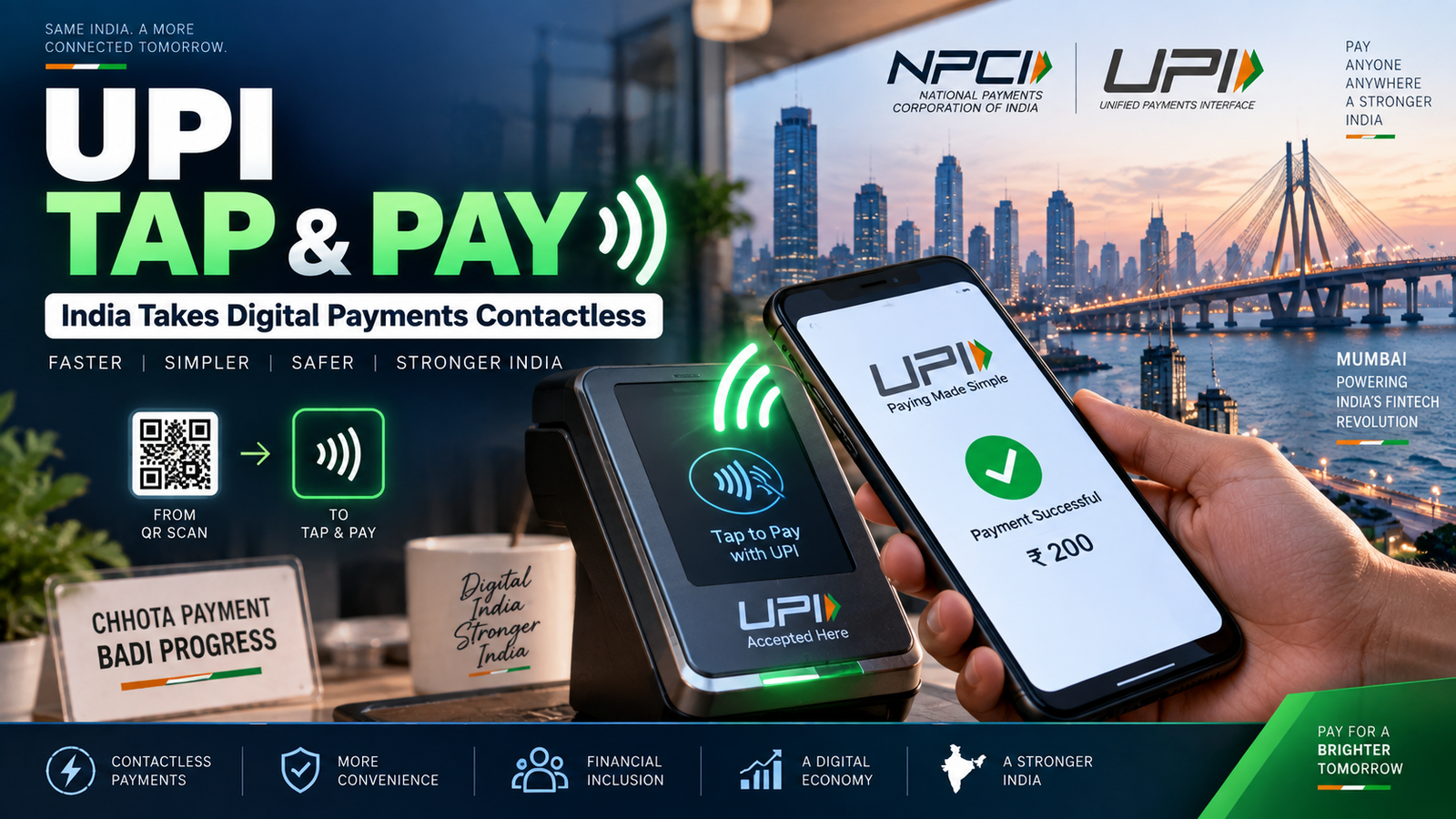
UPI Tap & Pay
Category: Economy & Banking | Science & Technology | Current Affairs
Date: September 11, 2026
Exam Relevance: UPSC, SSC, Banking, Railway, Defence, State PSC
India’s digital-payment ecosystem has taken another step forward with the introduction of a Tap & Pay facility on UPI, allowing users to make contactless payments by tapping an NFC-enabled smartphone on a compatible payment point.
The development was announced during the Global Fintech Fest 2026 in Mumbai and comes as UPI continues to expand its role as one of the world’s largest real-time retail payment systems. Reuters reported on September 10 that the new functionality uses Near Field Communication (NFC) and is designed to enable contactless UPI payments without the conventional QR-scanning process.
For competitive-exam aspirants, this is an important current-affairs topic because it connects UPI, NPCI, digital payments, NFC, financial inclusion, Digital Public Infrastructure, fintech and India’s digital economy.
What Happened?
The National Payments Corporation of India (NPCI) has introduced a newer contactless experience for UPI transactions called UPI Tap & Pay.
Instead of opening the camera and scanning a conventional QR code, a user with a compatible NFC-enabled smartphone can use the Tap & Pay option and bring the phone close to a compatible UPI Smart Tag or NFC-enabled QR point.
NPCI’s product documentation explains that Tap & Pay captures the merchant’s UPI ID/VPA through NFC rather than through camera-based QR scanning.
The development was highlighted at the Global Fintech Fest 2026 in Mumbai, where NPCI Non-Executive Chairman Ajay Kumar Choudhary announced the new functionality.
How Does UPI Tap & Pay Work?
The process is relatively simple:
Step 1: Open a compatible UPI application.
Step 2: Select Tap & Pay.
Step 3: Enter the payment amount.
Step 4: Tap the NFC-enabled smartphone on the merchant’s compatible UPI Smart NFC QR or Smart Tag.
Step 5: Authenticate the transaction where required.
NPCI’s product overview says the service works with NFC-capable mobile devices and can use UPI LITE for eligible low-value transactions, while higher-value transactions can require UPI PIN authentication.
What is NFC?
One of the most important concepts for exams in this news is NFC.
NFC = Near Field Communication
NFC is a short-range wireless communication technology that allows compatible devices to exchange information when brought very close to each other.
It is widely used for:
- Contactless payments
- Transit cards
- Access systems
- Digital identity applications
- Device pairing
In UPI Tap & Pay, NFC provides the communication channel through which the payment information can be obtained from a compatible merchant point.
Exam Connection
Remember:
NFC → Short-range wireless communication → Contactless interaction
Why Is This Important for India’s Digital Payment Ecosystem?
1. UPI Moves Beyond QR Scanning
QR codes have become one of the most recognisable symbols of India’s digital-payment revolution.
However, Tap & Pay adds another interaction model:
Scan → Tap
Instead of using the camera to scan a QR code, users can interact with a compatible NFC payment point by tapping their device.
This makes UPI more closely aligned with the global trend towards contactless payments.
2. Faster Payment Experience
Contactless payments can reduce the number of steps required to initiate a transaction.
For everyday transactions, particularly at high-volume locations, this can make digital payments more convenient.
3. Supports the Evolution of Digital Public Infrastructure
India’s digital ecosystem is increasingly moving from individual applications towards interoperable public digital infrastructure.
UPI is one of the strongest examples of this approach.
It allows users to connect participating bank accounts through UPI-enabled applications and make instant payments across participating banks and merchants.
Tap & Pay builds another layer of convenience on top of this existing infrastructure.
UPI and India’s FinTech Revolution
The new feature is part of a much larger transformation.
India’s fintech ecosystem has evolved from simple electronic fund transfers into a wide range of services.
These include:
- QR-based payments
- Contactless payments
- UPI Lite
- UPI AutoPay
- Credit on UPI
- RuPay Credit Card on UPI
- Conversational payments
- Cross-border UPI services
NPCI’s current product ecosystem includes several of these services, demonstrating how UPI is becoming a broader payment platform rather than merely a QR-scanning system.
What is UPI Lite?
UPI Lite is designed for smaller-value payments and provides a simplified payment experience.
NPCI says UPI Lite is designed for low-value transactions below ₹1,000, with the aim of improving convenience and reducing load on banks’ core banking systems.
UPI Lite can also be relevant to Tap & Pay.
NPCI’s Tap & Pay documentation says that for eligible transactions up to ₹500, UPI Lite can be used if enabled; transactions above that threshold can use UPI PIN authentication through the bank account.
Important Exam Point
Do not confuse:
UPI Lite → Simplified low-value UPI payments
with
UPI Tap & Pay → NFC-based contactless payment interaction
They are related technologies but not the same thing.
UPI’s Scale Makes This Development Significant
The timing is important because UPI is already operating at enormous scale.
According to Reuters, UPI processed approximately 24.51 billion transactions worth ₹29.82 trillion in August 2026.
At this scale, even a small improvement in the payment experience can potentially affect millions of transactions.
This is why developments in UPI are important not only for technology but also for:
- Banking
- Financial inclusion
- Digital commerce
- Consumer behaviour
- India’s fintech industry
UPI and Financial Inclusion
Digital payments can help reduce dependence on cash and improve access to formal financial services.
UPI’s interoperable design allows customers to make payments using participating bank accounts through UPI-enabled applications.
This can benefit:
- Small merchants
- Street vendors
- Small businesses
- Consumers
- Digital-commerce platforms
The broader objective is to make digital payments fast, accessible and interoperable.
What Challenges Remain?
Despite the benefits, contactless digital payments also raise important questions.
Cybersecurity
As digital transactions grow, protecting payment credentials and user accounts becomes increasingly important.
Device Compatibility
Tap & Pay requires compatible NFC-enabled hardware and supporting payment infrastructure.
User Awareness
Consumers need to understand how to authenticate payments and avoid fraudulent requests.
Digital Divide
Not every user has access to a smartphone or NFC-enabled device.
Therefore, new payment technologies need to complement — rather than completely replace — existing payment methods.
UPI vs Traditional QR Payment
| Feature | UPI QR Payment | UPI Tap & Pay |
|---|---|---|
| Main technology | QR code | NFC |
| User action | Scan QR | Tap device |
| Camera required | Generally yes | No camera scanning required |
| Contactless | Yes | Yes |
| Compatible hardware | Smartphone + QR | NFC-enabled smartphone + compatible NFC payment point |
| Core payment network | UPI | UPI |
| Main advantage | Universal QR-based acceptance | Faster contactless interaction |
UPI vs NFC: What Students Should Remember
A common exam trap is to treat UPI and NFC as competing technologies.
They are not.
UPI is a payment system/interface ecosystem, while NFC is a short-range wireless communication technology.
In Tap & Pay:
NFC = Communication Technology
UPI = Payment Infrastructure
Together, they enable a contactless UPI payment experience.
Why This News Matters for Competitive Exams
This one development can be connected with several examination subjects.
UPSC
GS Paper III
- Science & Technology
- Digital Economy
- FinTech
- Financial Inclusion
- Digital Infrastructure
Banking Exams
Questions can focus on:
- UPI
- NPCI
- NFC
- UPI Lite
- Digital payments
- Financial inclusion
SSC & Railway Exams
Possible factual questions include:
- Full form of UPI
- Full form of NFC
- Organisation operating UPI
- Meaning of contactless payment
- Difference between QR and NFC
Defence Exams
The topic can also be connected to:
- Cybersecurity
- Digital infrastructure
- Emerging technologies
Important Current Affairs Facts
| Fact | Answer |
|---|---|
| New UPI feature | UPI Tap & Pay |
| Organisation | National Payments Corporation of India (NPCI) |
| Core technology | NFC |
| NFC full form | Near Field Communication |
| Main use | Contactless UPI payments |
| Traditional alternative | QR Scan & Pay |
| Event where new functionality was highlighted | Global Fintech Fest 2026 |
| Location | Mumbai |
| August 2026 UPI transactions | 24.51 billion |
| August 2026 UPI transaction value | ₹29.82 trillion |
| UPI Lite low-value threshold | Below ₹1,000 |
| Tap & Pay + UPI Lite threshold mentioned by NPCI | Up to ₹500 |
| UPI pilot launch | April 11, 2016 |
NPCI identifies UPI as a system that allows users to link multiple participating bank accounts through a UPI application and make instant payments; the UPI pilot was launched on April 11, 2016.
Competitive Exam MCQs
Q1. The recently highlighted UPI Tap & Pay facility primarily uses which technology?
A. Bluetooth
B. NFC
C. GPS
D. RFID only
Answer: B. NFC
Q2. NFC stands for:
A. National Financial Communication
B. New Financial Connectivity
C. Near Field Communication
D. Network Field Connectivity
Answer: C. Near Field Communication
Q3. Consider the following statements:
- UPI is operated within an ecosystem developed by NPCI.
- UPI Tap & Pay uses NFC technology.
- UPI and NFC are both payment systems.
Which of the statements given above is/are correct?
A. 1 only
B. 1 and 2 only
C. 2 and 3 only
D. 1, 2 and 3
Answer: B. 1 and 2 only
Explanation: UPI is a digital-payment infrastructure/interface ecosystem, while NFC is a short-range wireless communication technology.
Q4. Which organisation is primarily associated with the development and operation of India’s UPI ecosystem?
A. SEBI
B. NPCI
C. TRAI
D. IRDAI
Answer: B. NPCI
Q5. Which of the following correctly describes UPI Tap & Pay?
A. A replacement for India’s banking system
B. An NFC-based contactless payment facility within the UPI ecosystem
C. A cryptocurrency payment platform
D. A blockchain-based international currency
Answer: B. An NFC-based contactless payment facility within the UPI ecosystem
Key Takeaway
India’s latest UPI development shows that the country’s digital-payment revolution is entering a new phase.
The evolution is moving from:
Cash → Cards → QR Payments → Contactless UPI → AI-enabled Digital Payments
For competitive exams, remember the most important connection:
UPI → NPCI → Digital Public Infrastructure → NFC → Tap & Pay → FinTech → Financial Inclusion
Understanding this relationship is much more useful than simply memorising that a new payment feature was introduced.
SSI — Learn Today. Lead Tomorrow.