
Global Fintech Fest 2026: India’s FinTech Revolution Enters a New Era
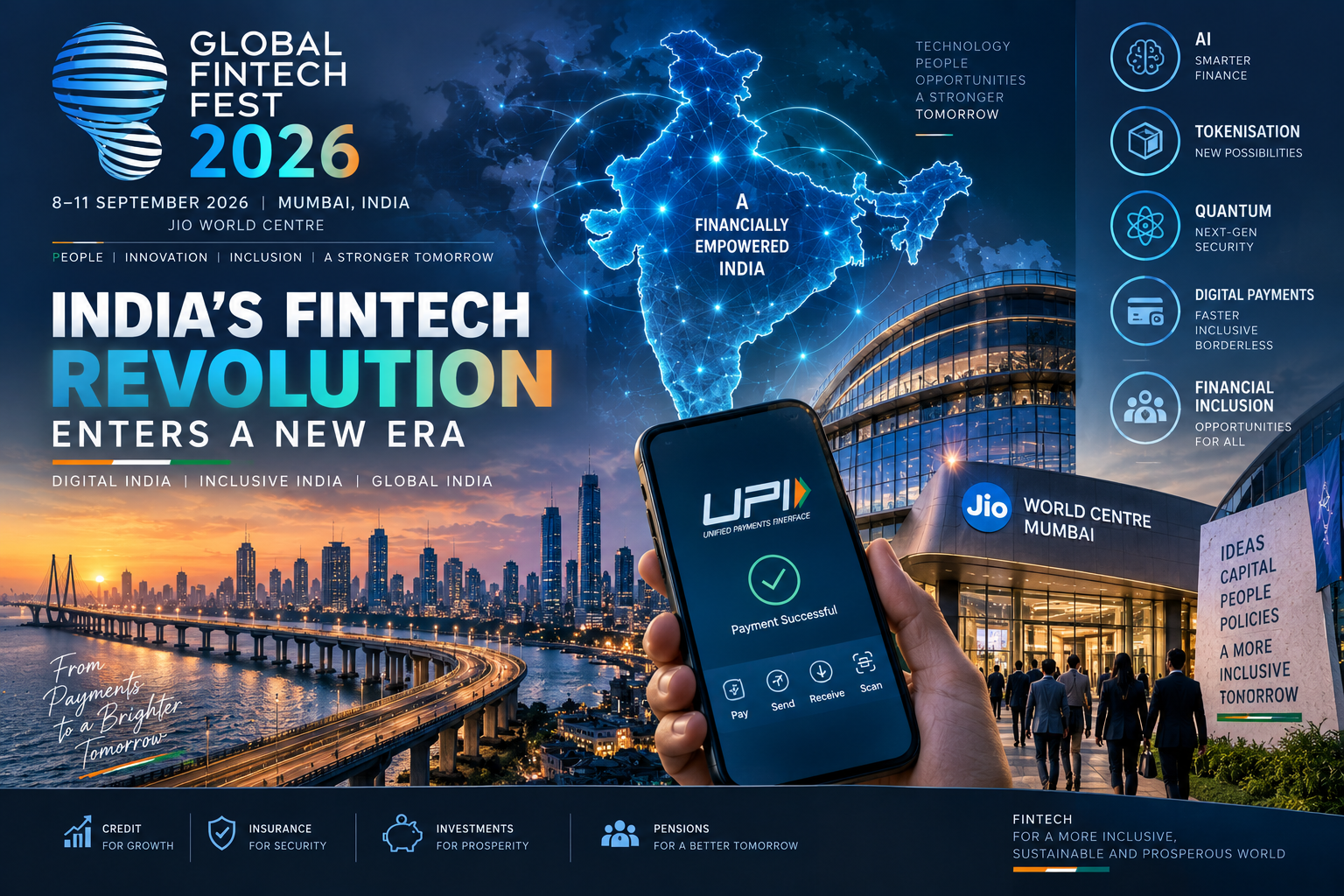
Global Fintech Fest 2026: India’s FinTech Revolution Enters a New Era
Category: Economy & Banking | Science & Technology | Current Affairs
Date: September 9, 2026
Exam Relevance: UPSC, SSC, Banking, Railway, Defence, State PSC
India’s fintech story has entered a new phase with the 7th Global Fintech Fest (GFF) 2026, being held in Mumbai from 8 to 11 September 2026.
The event has brought together policymakers, regulators, financial institutions, technology companies, startups and investors to discuss the future of financial technology.
The central theme of GFF 2026 is:
“Potential to Impact: Agentic AI, Tokenisation, Quantum – Trusted, Connected, Global Systems for Inclusive Finance.”
For competitive-exam aspirants, this event is important because it connects several major topics — UPI, Digital Public Infrastructure (DPI), Artificial Intelligence, financial inclusion, fintech regulation, cybersecurity, tokenisation and quantum technology.
What is Global Fintech Fest?
The Global Fintech Fest (GFF) is an international platform focused on the future of financial technology.
The 2026 edition is being held at the Jio World Centre in Mumbai and is described by the National e-Governance Division as one of the world’s largest annual fintech conferences.
The event brings together policymakers, central bankers, regulators, financial institutions, startups, investors and technology leaders to discuss how technology can transform financial services.
The 2026 edition is particularly significant because the discussion has moved beyond traditional digital payments towards AI-driven finance, tokenisation and advanced computing.
PM Modi Highlights India’s FinTech Journey
Prime Minister Narendra Modi inaugurated Global Fintech Fest 2026 in Mumbai on September 8.
During his address, he highlighted India’s fintech transformation and the success of UPI.
He also called for India’s fintech sector to expand beyond payments into areas such as:
- Credit
- Insurance
- Savings
- Investments
- Pensions
The Prime Minister also emphasised the importance of Agentic AI, tokenisation and quantum technologies in shaping the next phase of financial innovation.
Why is UPI So Important?
One of the biggest pillars of India’s fintech revolution is the Unified Payments Interface (UPI).
UPI allows users to make instant bank-to-bank digital payments through an interoperable payment infrastructure.
According to a PIB backgrounder released for GFF 2026, UPI recorded 24,509 million transactions in August 2026 and operates in 11 countries.
The government also highlighted that UPI handles nearly 50% of global real-time digital transaction volume.
This makes UPI an important example of India’s Digital Public Infrastructure approach.
What is Digital Public Infrastructure?
Digital Public Infrastructure (DPI) refers to shared digital systems that enable large-scale access to essential services.
India’s fintech ecosystem has developed around several major digital platforms, including:
Aadhaar
Aadhaar provides a digital identity layer that can support authentication and e-KYC.
UPI
UPI provides interoperable digital payment infrastructure.
DigiLocker
DigiLocker enables citizens to securely access and share digital documents.
Account Aggregator Framework
It enables consent-based sharing of financial information.
Together, these systems have helped create a digital ecosystem capable of serving millions of people at scale.
India’s FinTech Revolution Is Moving Beyond Payments
One of the most important messages from GFF 2026 is that India’s fintech sector cannot remain focused only on digital payments.
The next phase could involve technology transforming:
Payments → Credit → Insurance → Investment → Pension → Wealth Management
This transition could make financial services more accessible and personalised.
For example, data-driven lending can help financial institutions assess borrowers more efficiently, while AI can assist in fraud detection, customer support and financial decision-making.
What is Agentic AI?
Agentic AI refers to AI systems capable of taking actions to achieve a defined objective rather than simply responding to individual prompts.
In financial services, agentic AI could potentially help with tasks such as:
- Financial planning
- Customer assistance
- Fraud detection
- Risk assessment
- Automated financial workflows
- Personalised financial recommendations
However, greater automation also creates new challenges involving cybersecurity, privacy, accountability and consumer protection.
This is why responsible AI and strong regulatory frameworks are becoming increasingly important.
What is Tokenisation?
Tokenisation refers to representing an asset or value digitally through a token on a digital system or blockchain-based infrastructure.
In finance, tokenisation could potentially be used for:
- Securities
- Bonds
- Funds
- Real-world assets
- Digital financial instruments
The technology could make certain financial processes more efficient and programmable.
However, tokenisation also raises questions regarding regulation, security, ownership and investor protection.
Quantum Technology and Finance
Another major theme of GFF 2026 is quantum technology.
Quantum computing has the potential to influence financial services through areas such as:
- Complex optimisation
- Risk modelling
- Financial simulations
- Cryptography
- Fraud detection
However, quantum computing is still an emerging technology, and its widespread commercial applications are still developing.
For exam aspirants, the key connection is:
Quantum Computing → Advanced Computation → Cybersecurity → Financial Technology
FinTech and Financial Inclusion
Technology is not only transforming urban banking.
It can also help bring financial services to people who have historically had limited access to formal banking.
The RBI Governor, Sanjay Malhotra, highlighted how fintech has helped extend financial services to different sections of society through platforms and systems including UPI, Aadhaar-enabled payments and the Jan Dhan ecosystem.
This makes fintech an important tool for financial inclusion.
Cybersecurity Becomes More Important
As financial transactions become increasingly digital, cybersecurity becomes a critical concern.
At GFF 2026, cybersecurity and ethical data protection were among the priorities highlighted for India’s fintech sector.
The challenge is simple:
More Digital Finance = More Convenience + Greater Cybersecurity Responsibility
A strong fintech ecosystem therefore requires not only innovation but also:
- Data protection
- Cybersecurity
- Consumer protection
- Regulatory oversight
- Responsible AI
Important Current Affairs Facts
| Topic | Key Fact |
|---|---|
| Event | Global Fintech Fest 2026 |
| Edition | 7th |
| Location | Mumbai |
| Venue | Jio World Centre |
| Dates | 8–11 September 2026 |
| Main Theme | Potential to Impact |
| Key technologies | Agentic AI, Tokenisation, Quantum |
| Major Indian fintech platform | UPI |
| UPI August 2026 transactions | 24,509 million |
| UPI international presence | 11 countries |
| Important concept | Digital Public Infrastructure |
| RBI Governor | Sanjay Malhotra |
These figures and event details are based on official PIB/Government and GFF material.
Why This News Matters for Competitive Exams
This single event can be connected to multiple parts of the syllabus.
UPSC
GS Paper III
- Indian Economy
- Science & Technology
- Digital Infrastructure
- Artificial Intelligence
- Financial Inclusion
- Cybersecurity
GS Paper II
- Government policies
- Digital governance
- Regulation
- Inclusive development
SSC & Banking Exams
Possible questions include:
- Full form of UPI
- Meaning of fintech
- Digital Public Infrastructure
- Global Fintech Fest
- Role of RBI
- Financial inclusion
- Agentic AI
- Tokenisation
Railway & Defence Exams
Questions may connect fintech with:
- Digital payments
- Cybersecurity
- AI
- Emerging technologies
- Digital India
Competitive Exam MCQs
Q1. Global Fintech Fest 2026 is being held in which city?
A. Bengaluru
B. Mumbai
C. New Delhi
D. Hyderabad
Answer: B. Mumbai
Q2. Which of the following is the theme of Global Fintech Fest 2026?
A. Digital India for All
B. FinTech for a Developed India
C. Potential to Impact: Agentic AI, Tokenisation, Quantum
D. One World, One Payment System
Answer: C. Potential to Impact: Agentic AI, Tokenisation, Quantum
Q3. UPI stands for:
A. Unified Payment Interface
B. Universal Payments Infrastructure
C. Unified Payments Interface
D. Universal Payment Integration
Answer: C. Unified Payments Interface
Q4. Which of the following are major components of India’s Digital Public Infrastructure ecosystem?
- Aadhaar
- UPI
- DigiLocker
A. 1 only
B. 1 and 2 only
C. 2 and 3 only
D. 1, 2 and 3
Answer: D. 1, 2 and 3
Q5. Consider the following pairs:
| Technology | Possible Financial Application |
|---|---|
| Agentic AI | Automated financial workflows |
| Tokenisation | Digital representation of assets |
| Quantum Computing | Advanced optimisation and modelling |
Which of the above pairs is/are correctly matched?
A. 1 only
B. 1 and 2 only
C. 2 and 3 only
D. 1, 2 and 3
Answer: D. 1, 2 and 3
Key Takeaway
India’s fintech story is moving beyond simply making payments digital.
The next phase is about creating a trusted, intelligent and globally connected financial ecosystem powered by technologies such as AI, tokenisation and quantum computing.
For competitive-exam aspirants, remember this chain:
GFF 2026 → UPI → Digital Public Infrastructure → Financial Inclusion → Agentic AI → Tokenisation → Quantum Technology → Cybersecurity
Understanding these connections can help turn a current-affairs headline into questions across Economy, Science & Technology, Governance and Banking.
SSI — Learn Today. Lead Tomorrow.