India Completes 2,800+ km Dedicated Freight Corridor: Why It Matters for Competitive Exams
India Completes 2,800+ km Dedicated Freight Corridor: Why It Matters for Competitive Exams
Category: Current Affairs | National Affairs | Economy & Infrastructure
Date: September 9, 2026
Exam Relevance: UPSC, SSC, Banking, Railways, Defence Exams, State PSCs
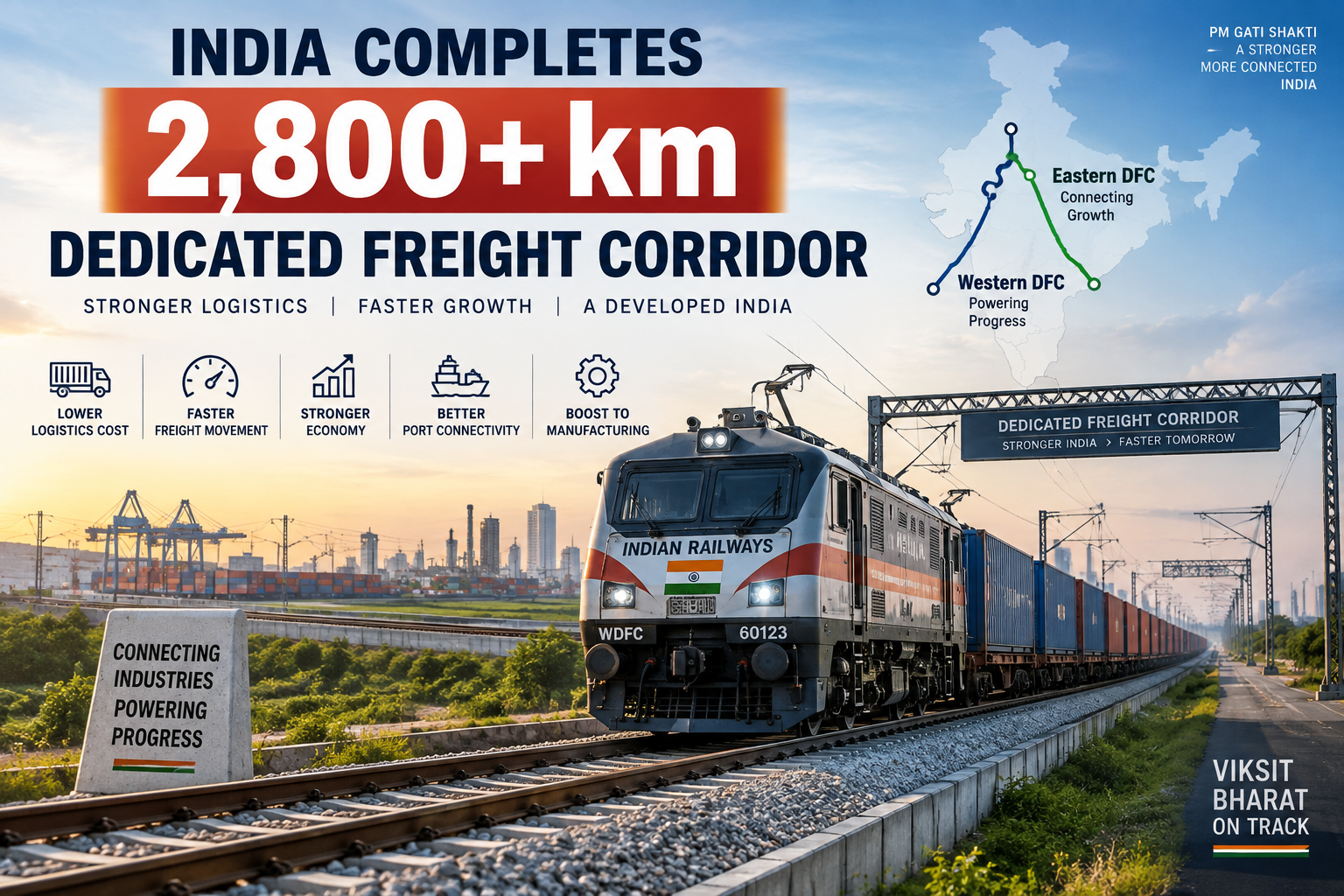
India has achieved a major milestone in its infrastructure and logistics sector with the completion of more than 2,800 km of the Dedicated Freight Corridor (DFC).
The development was highlighted on September 8, 2026, when Prime Minister Narendra Modi dedicated key sections of the Western Dedicated Freight Corridor during an event in Vadodara, Gujarat. The completion of the DFC is being seen as an important step towards improving India’s freight transportation system, reducing logistics bottlenecks and strengthening the country’s manufacturing and supply-chain network.
For competitive-exam aspirants, this development is important because it connects several topics frequently asked in General Awareness, Geography, Economy, Infrastructure, Indian Railways and Government Initiatives.
What is the Dedicated Freight Corridor?
The Dedicated Freight Corridor (DFC) is a specialised railway network designed exclusively for transporting goods and freight.
Unlike conventional railway routes where passenger and freight trains share the same tracks, dedicated freight corridors allow goods trains to operate on separate routes.
This separation helps improve:
- Speed of freight movement
- Freight-carrying capacity
- Reliability of supply chains
- Efficiency of railway operations
- Connectivity between industrial centres and ports
- Overall logistics efficiency
The completed DFC network spans more than 2,800 km and includes the Eastern Dedicated Freight Corridor (EDFC) and the Western Dedicated Freight Corridor (WDFC).
Why is the Completion of DFC Important?
India is one of the world’s fastest-growing major economies. As manufacturing, agriculture, exports and infrastructure expand, the country needs an efficient system to move raw materials and finished products.
The Dedicated Freight Corridor is designed to address exactly this requirement.
1. Faster Movement of Goods
Freight trains operating on dedicated routes do not have to compete with passenger trains for the same railway capacity.
This allows goods to move more efficiently between production centres, markets and ports.
2. Lower Logistics Costs
Efficient transportation can reduce the time and cost involved in moving goods.
Lower logistics costs can improve the competitiveness of Indian businesses, particularly manufacturers and exporters.
3. Decongestion of Existing Railway Routes
By shifting freight traffic to dedicated corridors, capacity can be released on conventional railway routes.
This can potentially allow passenger trains to operate more efficiently on existing networks.
4. Boost to Manufacturing
Better freight connectivity can support India’s manufacturing ecosystem by connecting industrial areas with major markets and ports.
This is particularly important for India’s broader objective of strengthening domestic manufacturing and supply chains.
5. Support for Exports
Efficient movement of goods from factories and agricultural centres to ports is essential for international trade.
A stronger freight network can therefore contribute to India’s export competitiveness.
DFC and PM Gati Shakti
The completion of the Dedicated Freight Corridor is also significant in the context of PM Gati Shakti – National Master Plan.
PM Gati Shakti focuses on integrated infrastructure planning and better coordination between different modes of transportation.
The DFC can work alongside roadways, ports, industrial corridors and other logistics infrastructure to create a more connected transportation ecosystem.
The Prime Minister’s Office described the completion of the 2,800+ km DFC as a major milestone for Gati Shakti and India’s logistics transformation.
Eastern vs Western Dedicated Freight Corridor
One important point for competitive examinations is that the DFC is not a single corridor.
It consists of two major corridors:
Eastern Dedicated Freight Corridor (EDFC)
The Eastern DFC connects the northern and eastern parts of India and is designed to facilitate the movement of freight across important industrial and agricultural regions.
Western Dedicated Freight Corridor (WDFC)
The Western DFC connects the northern industrial belt with the western coast and major ports, including the Jawaharlal Nehru Port (JNPT) region.
The completion of key sections of the Western DFC was formally dedicated to the nation in Gujarat on September 8, 2026.
How Will DFC Benefit the Indian Economy?
The importance of the DFC goes beyond railways.
A modern freight network can influence several sectors of the economy.
Agriculture: Faster transportation can help agricultural products reach markets more efficiently.
Manufacturing: Industries can receive raw materials and dispatch finished products more efficiently.
Ports: Better rail connectivity can improve the movement of export-import cargo.
Logistics: Dedicated freight infrastructure can improve supply-chain efficiency.
Employment: Large infrastructure and logistics ecosystems can create direct and indirect employment opportunities.
The larger objective is to create an infrastructure network capable of supporting India’s long-term economic growth.
Why is This News Important for Competitive Exams?
The DFC story can be connected with several areas of the competitive-exam syllabus.
UPSC
GS Paper III: Infrastructure, Indian Economy, Logistics, Transport
Possible questions can focus on the role of dedicated freight corridors in reducing logistics costs and improving India’s competitiveness.
SSC & Railway Exams
Questions may test:
- Full form of DFC
- Eastern and Western DFC
- Major routes
- Important ports
- Indian Railways
- PM Gati Shakti
Banking & Other Government Exams
The topic can also be linked with:
- Infrastructure investment
- Logistics sector
- Manufacturing
- Economic growth
- Supply-chain efficiency
Important Facts to Remember
| Fact | Answer |
|---|---|
| Full Form | Dedicated Freight Corridor |
| Purpose | Dedicated transportation of freight/goods |
| Total completed network | 2,800+ km |
| Major corridors | Eastern DFC & Western DFC |
| Western DFC connects | Northern industrial belt with western ports |
| Major port associated with WDFC | JNPT |
| Related national initiative | PM Gati Shakti |
| Key sector | Infrastructure & Logistics |
| Major milestone announced | September 8, 2026 |
| Important location | Vadodara, Gujarat |
The Government stated on September 8 that the 2,800+ km Dedicated Freight Corridor had been completed and described it as a major milestone for India’s logistics transformation.
Competitive Exam Practice Questions
Question 1
Consider the following statements about the Dedicated Freight Corridor (DFC):
- It is designed primarily for the transportation of freight.
- It helps separate freight traffic from passenger railway traffic.
- It consists only of the Western Dedicated Freight Corridor.
Which of the statements given above is/are correct?
A. 1 only
B. 1 and 2 only
C. 2 and 3 only
D. 1, 2 and 3
Answer: B. 1 and 2 only
Question 2
The Dedicated Freight Corridor is most directly associated with which of the following?
A. Passenger railway services
B. Freight transportation and logistics
C. Inland water transport
D. Civil aviation
Answer: B. Freight transportation and logistics
Question 3
The completion of the 2,800+ km Dedicated Freight Corridor is particularly significant for which broader initiative?
A. PM Gati Shakti
B. Mission LiFE
C. Digital India
D. Skill India
Answer: A. PM Gati Shakti
Key Takeaway for Aspirants
The completion of India’s 2,800+ km Dedicated Freight Corridor is not merely a railway-related development. It represents a larger shift towards a faster, more integrated and efficient logistics system.
For competitive-exam aspirants, the most important approach is to connect this news with Indian Railways, infrastructure, logistics, PM Gati Shakti, manufacturing, ports, exports and economic growth.
Understanding these connections is more useful than simply memorising the headline.
Stay updated. Understand the news. Connect it with the syllabus.
SSI — Learn Today. Lead Tomorrow.