Nobel Prize in Physics 2026: Francis Halzen Wins for the IceCube Neutrino Observatory
On 6 October 2026, the Royal Swedish Academy of Sciences announced that the Nobel Prize in Physics 2026 has been awarded to 82-year-old Belgian-American physicist Francis Halzen, professor at the University of Wisconsin-Madison and principal investigator of the IceCube Neutrino Observatory. The Academy honoured him “for decisive contributions to the IceCube Neutrino Observatory and the discovery of high-energy neutrinos of astrophysical origin.” The announcement was made at 3:15 PM Indian Standard Time, and the prize carries 12 million Swedish kronor, about $1.2 million.
This prize celebrates one of the most remarkable scientific instruments ever built: a giant telescope carved out of Antarctic ice that does not look at light at all. Instead, it watches for neutrinos, ghost-like particles that travel across the universe almost untouched by anything in their path. Halzen spent decades turning an idea many considered impossible into the world’s largest neutrino telescope.
What Is the IceCube Neutrino Observatory?
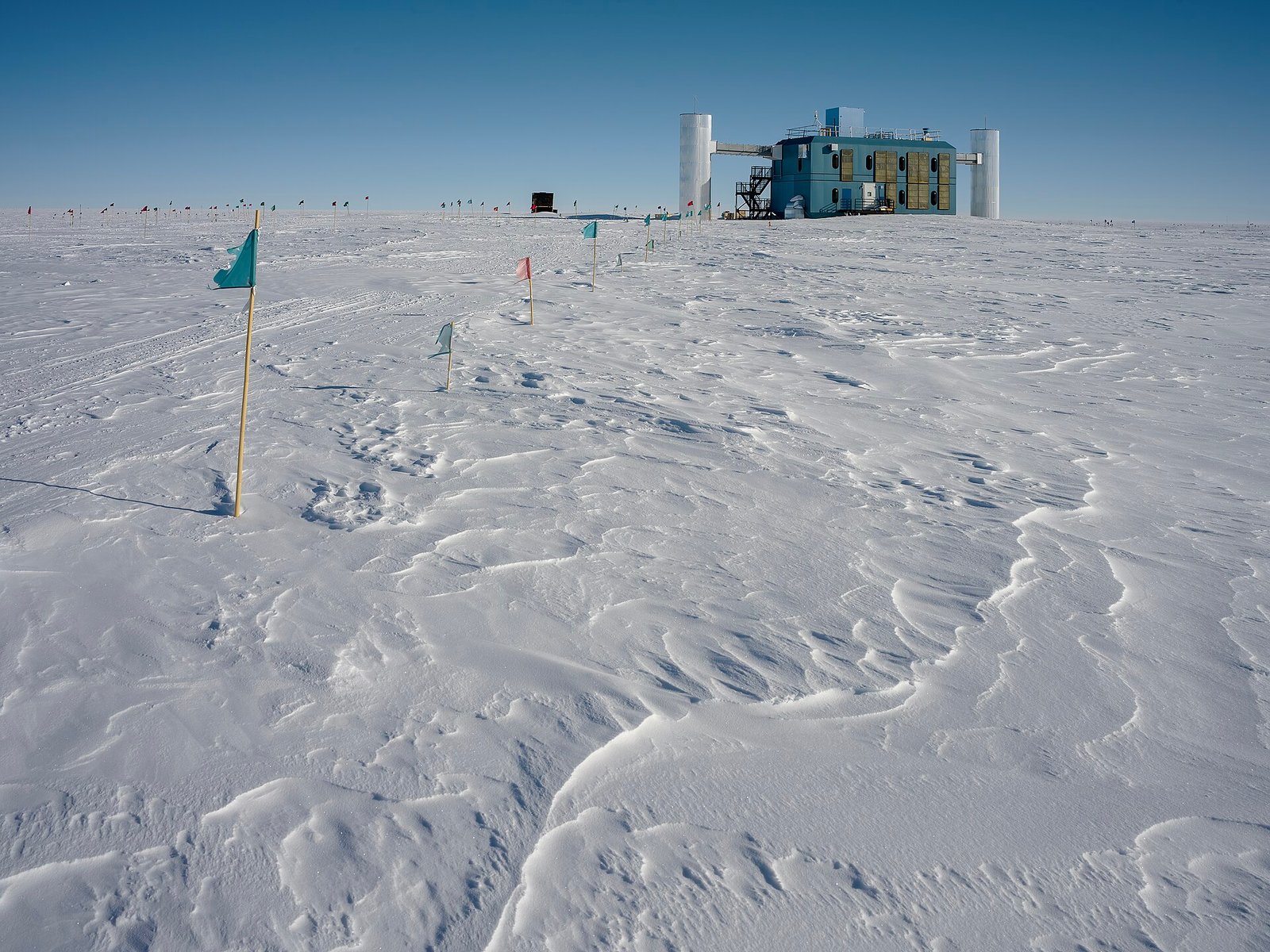
IceCube is buried in a cubic kilometre of ice at the South Pole, close to the Amundsen-Scott South Pole Station. More than 5,000 light sensors hang on long strings frozen into the ice, reaching a depth of about 2,500 metres. When a neutrino collides with an atom in the ice, it produces a faint blue flash of light, and the sensors record its direction and energy. The observatory has been fully operational since 2011.
Halzen first proposed the idea in 1988: use the clear, ancient ice of Antarctica as a natural particle detector. A smaller predecessor detector called AMANDA operated from 1995 to 2000 and proved that the concept worked. Construction of IceCube itself began in 2005, and it gradually grew into an instrument no one had ever attempted before.
The breakthrough came in 2013, when IceCube detected high-energy neutrinos, particles carrying tens of TeV of energy and more, roughly 100 times more energetic than anything produced at CERN’s Large Hadron Collider, arriving from beyond our own Galaxy. For the first time, scientists had proof that these ghostly particles are cosmic messengers travelling straight from violent events in deep space to Earth. Because neutrinos carry no electric charge, have almost no mass, barely interact with matter and are not bent by magnetic fields, they point straight back to their sources: exploding stars, gamma-ray bursts, black holes and neutron stars. Today IceCube detects roughly one high-energy neutrino per day.
Key Facts at a Glance
- Prize announced on 6 October 2026 by the Royal Swedish Academy of Sciences at 3:15 PM IST.
- Winner: Francis Halzen, 82, born 1944 in Tienen, Belgium; Belgian-American physicist at the University of Wisconsin-Madison.
- Citation: “for decisive contributions to the IceCube Neutrino Observatory and the discovery of high-energy neutrinos of astrophysical origin.”
- IceCube: one cubic kilometre of Antarctic ice at the South Pole, sensors down to about 2,500 metres, over 5,000 light sensors; fully operational since 2011.
- Timeline: idea conceived by Halzen in 1988; AMANDA predecessor ran 1995-2000; IceCube construction began 2005.
- 2013 breakthrough: detection of high-energy neutrinos, about 100 times more energetic than particles at CERN’s LHC, from beyond our Galaxy.
- Neutrinos have no electric charge and negligible mass, hardly interact with matter and are not deflected by magnetic fields, so they point straight back to their sources.
- Prize money: 12 million Swedish kronor (about $1.2 million); medals presented by Sweden’s King Carl XVI Gustaf in Stockholm on 10 December 2026.
- 2025 Physics prize went to John Clarke, Michel Devoret and John Martinis for quantum physics experiments relevant to quantum computing.
- India angle: the India-based Neutrino Observatory (INO) is a planned underground mega-science project under the Bodi West Hills in Theni district, Tamil Nadu (Department of Atomic Energy with TIFR and IMSc), aimed at studying atmospheric neutrinos.
Why This Matters for Competitive Exams
This topic is a goldmine for the Science and Technology sections of UPSC, SSC, banking, CDS and state PSC examinations. Questions can be framed on the winner’s name and nationality, the observatory’s location at the South Pole, the 2013 discovery, and basic neutrino properties such as their lack of electric charge and negligible mass.
Awards and honours are a permanent part of the current affairs syllabus, and Nobel Prizes are among the most frequently asked topics. Remember the full Nobel week of 2026: Medicine on 5 October (Karl Deisseroth, Peter Hegemann and Georg Nagel for light-gated ion channels and optogenetics), Physics on 6 October, Chemistry on 7 October, Literature on 8 October, Peace on 9 October and Economics on 12 October. Earlier neutrino-related Nobels are equally important: the 2015 prize to Takaaki Kajita and Arthur McDonald for neutrino oscillation, and the 2002 prize to Raymond Davis Jr. and Masatoshi Koshiba for detecting cosmic neutrinos.
The India connection makes this topic even more exam-relevant. The India-based Neutrino Observatory (INO), planned under the Bodi West Hills in Theni district of Tamil Nadu by the Department of Atomic Energy along with TIFR and IMSc, aims to study atmospheric neutrinos. It is a favourite example in UPSC Science and Technology questions on mega-science projects.
Practice MCQs for Competitive Exams
- Who was awarded the Nobel Prize in Physics 2026? (a) Takaaki Kajita (b) Francis Halzen (c) John Clarke (d) Peter Higgs
- The IceCube Neutrino Observatory is located at the: (a) North Pole (b) CERN, Geneva (c) South Pole (d) Atacama Desert
- IceCube is designed to detect which particle? (a) Proton (b) Electron (c) Neutrino (d) Photon
- In which year did IceCube achieve its breakthrough detection of high-energy cosmic neutrinos? (a) 2011 (b) 2013 (c) 2015 (d) 2020
- The India-based Neutrino Observatory (INO) is planned under the Bodi West Hills in which district? (a) Kolar, Karnataka (b) Theni, Tamil Nadu (c) Hanle, Ladakh (d) Sriharikota, Andhra Pradesh
Answer Key: 1-(b), 2-(c), 3-(c), 4-(b), 5-(b).